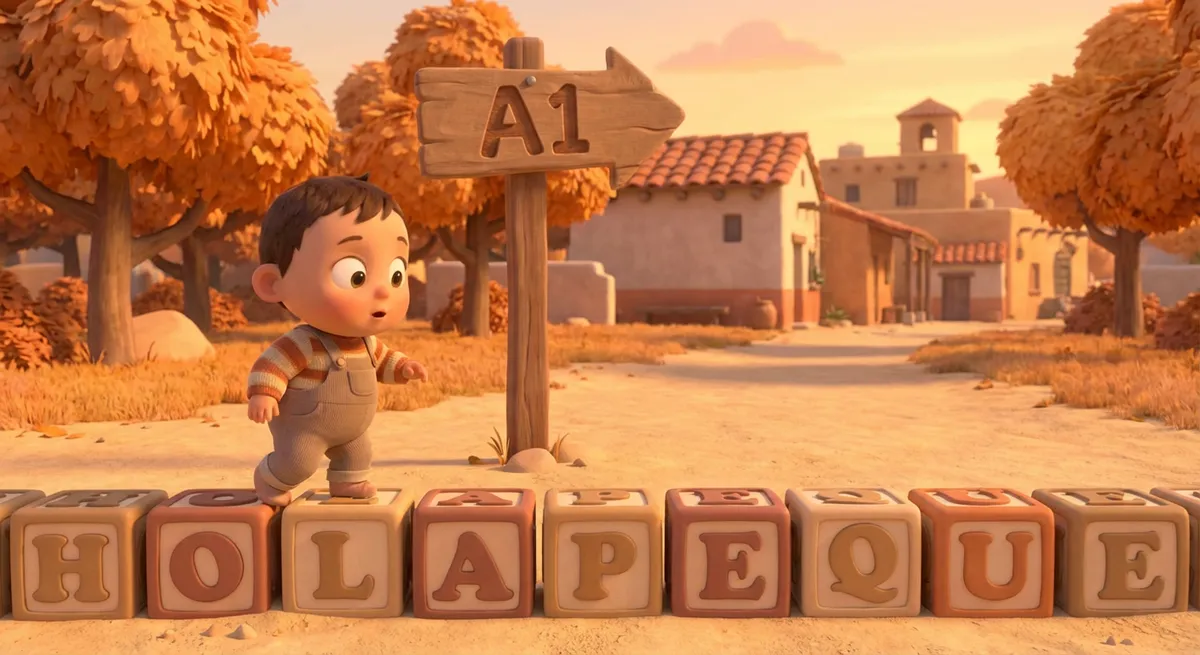
Spanish A1 for Beginners: a Checklist of Topics and Skills
Where do you start with Spanish? The A1 checklist: 8 grammar topics, 8 vocabulary themes and your first real skills — plus a free level test.
You have decided to learn Spanish — congratulations! It is one of the best decisions you could have made. Spanish is one of the world's most widely spoken languages, and starting to speak it is easier than you think.
In this article we have put together an A1 checklist — a concrete plan of what to learn and what you will be able to do at this level.
What does level A1 mean in practice?
A1 is the very first level of the European CEFR scale. At level A1 you will be able to:
- Introduce yourself and talk about yourself: your name, age, where you are from
- Ask simple questions and understand simple answers
- Order food in a café and ask the price in a shop
- Get by in a hotel, at the airport or out on the street
- Understand slow and clear speech on familiar topics
- Write a short message or fill in a form
Not sure what your level is right now? Take the free level test.
The A1 grammar checklist: 8 key topics
Work through these topics in order, from simple to complex.
1. The alphabet and pronunciation
Spanish is read almost exactly as it is written. Learn the special letters and sounds — ñ, ll, rr, j — and remember that h is written but never pronounced. These few basics let you read most Spanish words aloud.
2. Articles (el, la, un, una)
If your language has no articles, this is a new concept. El/la are the definite articles, un/una the indefinite ones.
3. Gender and number of nouns
Words ending in -o are usually masculine, words ending in -a are feminine. Plurals take -s or -es.
4. Presente de indicativo — the present tense
The most important A1 topic. Three conjugation classes: -ar, -er, -ir. Practise them one class at a time, starting with regular verbs.
5. The verbs ser and estar
Ser is typically used for origin and defining characteristics (Soy de España), estar for states and location (Estoy en casa). This is a helpful rule of thumb rather than an absolute rule — Spanish has exceptions, and you will refine the distinction as you progress.
6. Question words
| Spanish | English | Example |
|---|---|---|
| ¿Qué? | What? | ¿Qué es esto? |
| ¿Quién? | Who? | ¿Quién eres? |
| ¿Dónde? | Where? | ¿Dónde está el baño? |
| ¿Cuándo? | When? | ¿Cuándo es la clase? |
| ¿Cuánto? | How much? | ¿Cuánto cuesta? |
| ¿Cómo? | How? | ¿Cómo te llamas? |
7. Possessives and demonstratives
Mi, tu, su (my, your, his/her) are used before a noun, and este, esta, esto mean "this".
8. Numbers from 0 to 100
Prices, time, age, addresses. Learn 1 to 30 individually, then the tens and the pattern for building the rest.
The A1 vocabulary checklist: 8 topic blocks
A common estimate puts A1 vocabulary at 500–800 words — the exact figure varies, and there is no fixed official requirement. Learn it in topic blocks:
1. Greetings and polite phrases
Hola, buenos días, buenas tardes, por favor, gracias, lo siento, perdona.
2. Meeting people and talking about yourself
Me llamo..., soy de..., tengo ... años, trabajo en..., estudio...
3. Numbers, days of the week and months
Numbers from 0 to 100, days (lunes–domingo), months (enero–diciembre). Flashcards are the easiest way to memorise them.
4. Family and close relatives
Madre, padre, hermano, hermana, hijo, hija, abuelo, abuela, amigo.
5. Colours and clothes
Rojo, azul, verde, blanco, negro + camiseta, pantalones, zapatos.
6. Food and drink
Agua, café, pan, arroz, pollo, ensalada, cerveza, vino.
7. Home and the city
Casa, habitación, calle, plaza, tienda, restaurante, hospital, estación.
8. Descriptive adjectives
Grande, pequeño, bueno, malo, bonito, nuevo, viejo, fácil, difícil.
Illustrative timeframes: how long can A1 take?
| Intensity | Hours per week | Time to A1 |
|---|---|---|
| Intensive course | 15–20 hours | 3–4 weeks |
| Standard pace | 4–6 hours | 2–3 months |
| Self-study | 2–3 hours | 4–6 months |
These figures are illustrative: there is no fixed official hour requirement, and real pace varies by programme and learner. Commonly cited planning estimates put A1 at around 60–80 hours of study.
5 tips for absolute beginners
1. Do not try to learn everything at once
Follow the checklist in order. It is better to know 50 words well than 200 badly.
2. Speak from day one
Do not wait until you "know enough". Say words out loud, repeat phrases.
3. Study a little every day
For most learners, 15 minutes every day works better than 2 hours once a week — short regular sessions are also easier to keep up.
4. Alternate grammar with games
Short games in Spanish make daily practice fun and help you stick with it.
5. Do not be afraid of mistakes
Every mistake is a step towards correct speech. Many Spanish speakers appreciate it when you try to speak their language.
What comes after A1?
Once you have covered every topic in this checklist you will have a solid foundation for level A2 — past tenses, more complex structures and free-flowing dialogues. Our A2 checklist picks up exactly where this one ends.
Start right now:
- Find out your level
- Practise present-tense verbs a little every day
- Learn your first 50 words with flashcards
![Spanish A2: a Grammar and Vocabulary Checklist [2026]](https://mduvwmfuxtdyzbiplsbj.supabase.co/storage/v1/object/public/prod-assets/blog/ispanskiy-a2-chek-list-grammatiki-leksiki.webp)