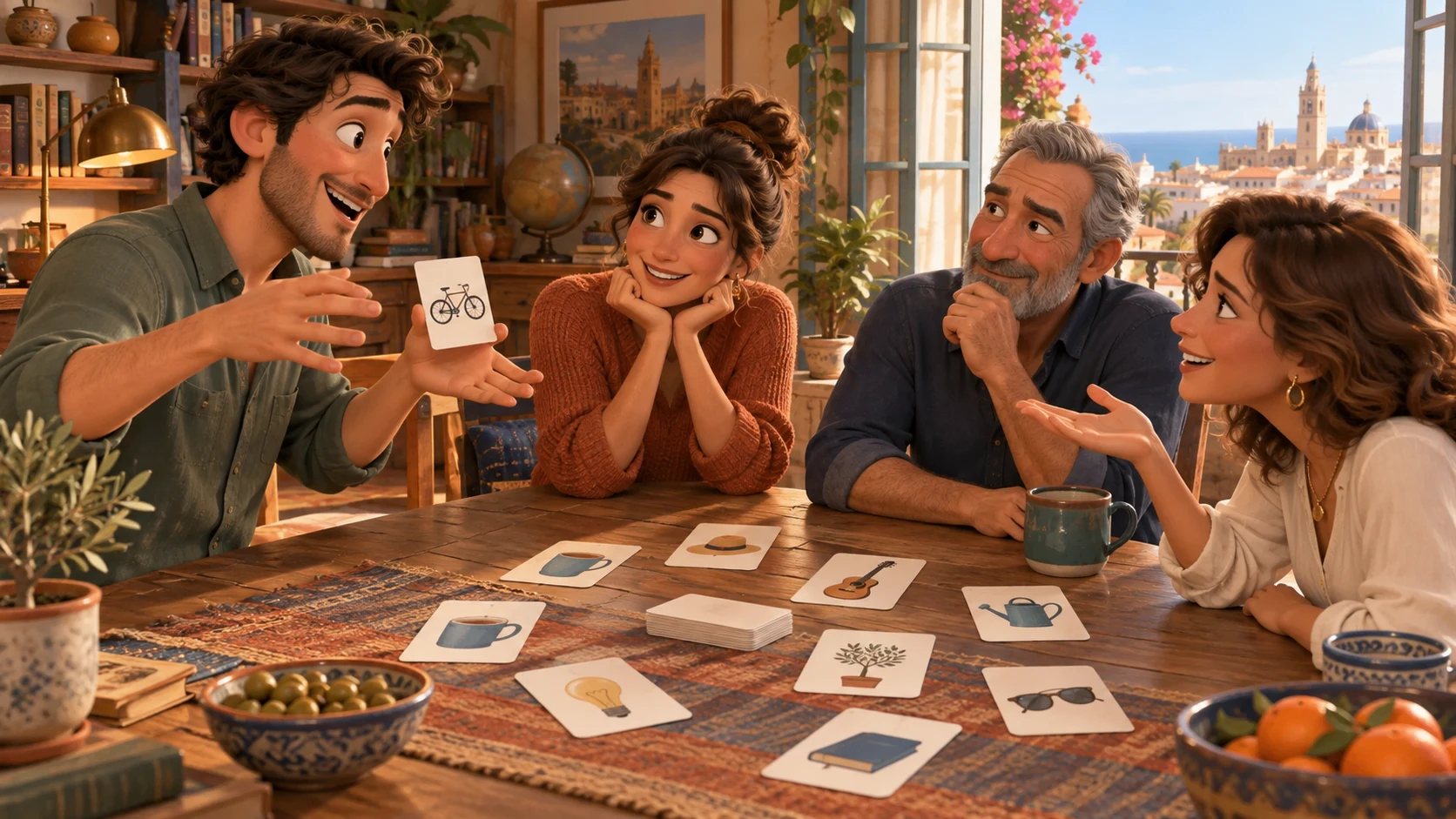
A Spanish games evening: 24 cards for speaking practice
Play an original description game with 24 printable cards, clear rules, two support levels and phrases for taking turns in Spanish.
At a Spanish-speaking games table, knowing the names of objects is only part of joining in. You also need to ask whose turn it is, check a rule and give somebody time to answer. This article provides one original description game with 24 ready-to-use cards, a demonstration and useful phrases. You do not need to buy a commercial game.
The cards are for voluntary practice with two to four people. They can suit a quiet pair as well as a small sociable group. This is a home practice activity, not a promise that this particular game appears in Taronja's timetable. Choose the amount of support that lets everyone participate.
Prepare the table
Print the card section and cut between numbered cards, or copy the cards onto separate pieces of paper. Each speaker must be able to see their own card while keeping it hidden from the guessers. The target word, sample clue and suggested question are all printed on the card. Only the speaker sees them; listeners can invent their own question.
Have a spare sheet for useful expressions. Start with six familiar cards and add the rest later if you want. You do not need a timer. Agree that anyone may change a card or pass a turn without losing a point because of their language level. Choose the next speaker in a fixed order around the table.
Three rules to explain before playing
- Draw and describe. Take one card and describe the object in Spanish without saying its target name. You may read the supplied clue or create your own.
- Ask and answer. The listeners choose one person to ask one clarification question. The speaker answers, and the listeners make one agreed guess.
- Reveal and continue. Reveal the intended word, briefly discuss another reasonable answer if necessary, and pass the turn to the next speaker.
A short Spanish explanation is: Coge una tarjeta y describe el objeto sin decir su nombre. Los demás pueden hacer una pregunta y después dar una respuesta. Al final, muestra la palabra y pasa el turno. “One question” means one question from the listening side as a whole, not one question from each listener. Requests to repeat the wording do not use up the single question about the object.
The default version is cooperative and has no scores. If you want a shared target, count completed turns, including turns where somebody needed help. Never make somebody continue a card they do not want. A broad description can have more than one reasonable solution; the printed word is the intended answer, not proof that all alternatives are nonsense.
Demonstrate one turn together
The speaker sees el paraguas and says: Lo usamos cuando llueve. Se puede abrir y cerrar. A listener asks: ¿Lo llevas fuera de casa? The speaker replies: Sí, lo llevo cuando voy por la calle. The listeners agree on ¿Es un paraguas? and the speaker reveals the word.
Now try a different clue for the same object: Tiene un mango y me ayuda cuando llueve. Neither description has to sound like a dictionary definition. The speaker needs to provide enough information for a useful guess. If you do not know mango, use the first clue or ask for help afterwards.
Keep these phrases beside the cards
- ¿A quién le toca? asks whose turn it is.
- Ahora te toca. tells the next person that it is their turn.
- ¿Puedes repetir la última parte? requests repetition of the last part.
- ¿Podemos hacer una pregunta antes de responder? checks the question rule.
- Necesito un momento para pensar. asks for thinking time.
- Prefiero cambiar de tarjeta. lets you change a card.
- Creo que es… porque… introduces a guess and a reason.
- Tu respuesta también tiene sentido. acknowledges a plausible alternative.
Choose two phrases to use during the first round. You do not need to recite the entire list. If someone asks for time, wait rather than completing their sentence immediately. A more confident speaker can answer a requested vocabulary question without taking over the whole turn.
Choose the supported or extended mode
For a supported version, useful around A1 with help, the speaker may read the clue, use a gesture or make a simple drawing visible only to themselves before speaking. You can also look at a real object privately. Keep the answer hidden from listeners. The starts Es una cosa que…, Sirve para… and Lo usamos cuando… can help.
For an extended version, useful for many A2–B1 learners, create your own clue before consulting the printed one. Add a function, location or comparison, then answer the clarification in a complete sentence. These are flexible practice modes, not an official CEFR test or a fixed rule about what every learner at a level can do.
The 24 printable cards
There are six groups of four: home, kitchen, study, outdoors, clothing and everyday objects. The additional task is optional. Keep each complete card together when cutting; the person describing the object needs the answer as well as the clue.
Card 01: la mesa
Clue: Tiene una superficie y patas. Ponemos platos o libros encima.
Possible question: ¿La usas para comer?
Describe a table you know: where is it, and what do you put on it? Do not assume every example is made of wood.
Card 02: la silla
Clue: Es un asiento para una persona. Normalmente tiene respaldo.
Possible question: ¿Se puede mover?
Add a useful contrast with a bench. Keep the description about the number of people rather than an imagined colour.
Card 03: la llave
Clue: Es pequeña y sirve para abrir una cerradura. La llevo conmigo.
Possible question: ¿Abre una puerta?
Name the place where you keep this object without saying its name. A pocket and a bag are possible answers.
Card 04: la lámpara
Clue: Da luz. Podemos ponerla en una mesa para leer por la noche.
Possible question: ¿Necesita electricidad?
Explain why someone would use it while reading. Describe an ordinary example, without claiming that all designs work in the same way.
Card 05: la cuchara
Clue: Tiene un mango y una parte pequeña donde cabe comida líquida.
Possible question: ¿La usas con la sopa?
Give a soup example, then explain how the object differs from a fork. You may use a gesture in the supported mode.
Card 06: el vaso
Clue: Es un recipiente para beber. Este no tiene asa ni tapa.
Possible question: ¿Puedes poner agua dentro?
Describe one simple example. The clue refers to that example; it does not require you to explain every possible drinking container.
Card 07: el plato
Clue: Ponemos comida encima y lo llevamos a la mesa. Después lo lavamos.
Possible question: ¿Lo usas para servir comida?
Add a distinction from a glass using what goes on it or inside it. Choose a meal you can describe easily.
Card 08: la botella
Clue: Guarda líquido y suele tener un cuello estrecho. Podemos cerrarla con un tapón.
Possible question: ¿La llevas de viaje?
Mention a drink and a place where you use this container. Your example can be reusable; no particular material is required.
Card 09: el libro
Clue: Tiene páginas y una cubierta. Podemos leer una historia o buscar información.
Possible question: ¿Lo encuentras en una biblioteca?
Describe its purpose without naming a famous title. The clue should help someone who has never read your favourite story.
Card 10: el lápiz
Clue: Sirve para escribir o dibujar. Podemos borrar sus marcas con una goma.
Possible question: ¿Hay que sacarle punta?
Use the eraser clue to distinguish this object from a pen. You can describe a familiar school item without naming a brand.
Card 11: el cuaderno
Clue: Tiene hojas unidas. Escribimos nuestros apuntes y ejercicios en sus páginas.
Possible question: ¿Lo llevas a clase?
Explain what you write in it. Compare it with a printed story only if that helps the other player understand your clue.
Card 12: la mochila
Clue: Llevamos cosas dentro y la ponemos en la espalda con dos tirantes.
Possible question: ¿Cabe un cuaderno dentro?
Mention something you would carry to class. The capacity depends on your example, so do not turn size into a universal rule.
Card 13: el paraguas
Clue: Lo usamos cuando llueve. Se puede abrir y cerrar y tiene un mango.
Possible question: ¿Lo llevas fuera de casa?
Add where you put it when it is wet. Keep the object hidden from the guessers during this description round.
Card 14: la bicicleta
Clue: Tiene dos ruedas y pedales. Una persona puede usarla para desplazarse.
Possible question: ¿Necesitas pedalear?
Describe a journey you might make with it. The task is about language; you do not need to demonstrate any movement at the table.
Card 15: el banco
Clue: Es un asiento largo. Varias personas pueden sentarse juntas en un parque.
Possible question: ¿Lo encuentras al aire libre?
Keep this card about a seat. The same Spanish word has other meanings, but the park context identifies the intended answer here.
Card 16: el mapa
Clue: Representa lugares y caminos. Lo consultamos para orientarnos en una zona.
Possible question: ¿Puede estar en el móvil?
Compare a paper version with a digital version if you wish. Both can fit the intended word; explain the shared function.
Card 17: el zapato
Clue: Lo llevamos en el pie para salir. Normalmente usamos dos, uno en cada pie.
Possible question: ¿Te lo quitas en casa?
Describe where you would wear one ordinary example. You do not need specialist vocabulary for every kind of footwear.
Card 18: el sombrero
Clue: Lo ponemos en la cabeza. Este tiene un ala alrededor para dar sombra.
Possible question: ¿Lo usas cuando hace sol?
Use the brim clue to narrow the answer. If somebody suggests a cap, explain the example you are describing without dismissing their reasoning.
Card 19: el abrigo
Clue: Es una prenda que llevamos encima de otras para protegernos del frío.
Possible question: ¿Te lo pones en invierno?
Give a weather situation and describe where you leave the item indoors. An alternative clothing answer can be discussed if the clue is broad.
Card 20: la bufanda
Clue: Es una prenda larga. La ponemos alrededor del cuello cuando hace frío.
Possible question: ¿Cubre el cuello?
Explain how this item differs from a coat. Use the body part already in the clue as a helpful starting point.
Card 21: el teléfono
Clue: Sirve para llamar y hablar con alguien que está lejos. Este cabe en el bolsillo.
Possible question: ¿Puedes enviar mensajes con él?
Describe the mobile example used here. You may accept móvil as an appropriate answer and discuss the broader word afterwards.
Card 22: el reloj
Clue: Nos muestra la hora. Puede estar en una pared o en la muñeca.
Possible question: ¿Tiene números?
Choose a wall or wrist example and describe it. Analogue and digital versions both fit, so numbers are a question rather than a requirement.
Card 23: el billete
Clue: Lo compramos para hacer un viaje en tren. Puede indicar el trayecto y la fecha.
Possible question: ¿Lo enseñas durante el viaje?
Keep the train-travel context. The word can mean other things elsewhere; explain why this particular clue points to a ticket.
Card 24: la cartera
Clue: Es pequeña y sirve para guardar dinero y tarjetas. Podemos llevarla en un bolso.
Possible question: ¿Guardas tarjetas dentro?
Describe the wallet sense intended here. If a different object fits your description, add one concrete detail before revealing the target word.
Answer key and two blank cards
The intended answers are listed below by card number. Accept a sensible synonym where it fits the clue. For card 21, móvil fits the mobile-phone example. Discuss alternatives using the description actually given rather than demanding an exact memorised dictionary entry.
01 — la mesa; 02 — la silla; 03 — la llave; 04 — la lámpara; 05 — la cuchara; 06 — el vaso; 07 — el plato; 08 — la botella; 09 — el libro; 10 — el lápiz; 11 — el cuaderno; 12 — la mochila; 13 — el paraguas; 14 — la bicicleta; 15 — el banco; 16 — el mapa; 17 — el zapato; 18 — el sombrero; 19 — el abrigo; 20 — la bufanda; 21 — el teléfono; 22 — el reloj; 23 — el billete; 24 — la cartera.
Use lo for a masculine noun and la for a feminine noun.
Blank card 25
Secret word with article: ______. Function: Sirve para ______. One place: Lo/La encontramos en ______. A clarification question: ¿______? Write the intended answer on the card and keep the whole card hidden from listeners.
Blank card 26
Secret word with article: ______. Description: Tiene ______ y lo/la usamos cuando ______. A useful comparison: Es diferente de ______ porque ______. Check that your description does not contain the answer before giving the card to the next speaker.
Finish with one useful expression
After everyone has had a turn, ask each person to choose one expression worth using again. It might be a question about the rules rather than a new object word. Write a fresh example and say it to another person. If somebody wants a correction, check one manageable point and let them try the sentence again.
Can two people play? Yes: alternate describing and guessing. Must you compete? No; the main version has no scores. How do you help without translating everything? Offer a requested word, gesture or sentence start, then return the turn. Can you stop after six cards? Yes. The full deck gives you choices, not an obligation to finish every object.
If you enjoy this format and want more regular shared speaking practice, explore the intensive programme with conversation lessons in Valencia. Ask about the current format and your dates. You can bring an interest in games to the conversation without assuming that this exact activity is part of the course.
















































![Spanish A2: a Grammar and Vocabulary Checklist [2026]](https://mduvwmfuxtdyzbiplsbj.supabase.co/storage/v1/object/public/prod-assets/blog/ispanskiy-a2-chek-list-grammatiki-leksiki.webp)



