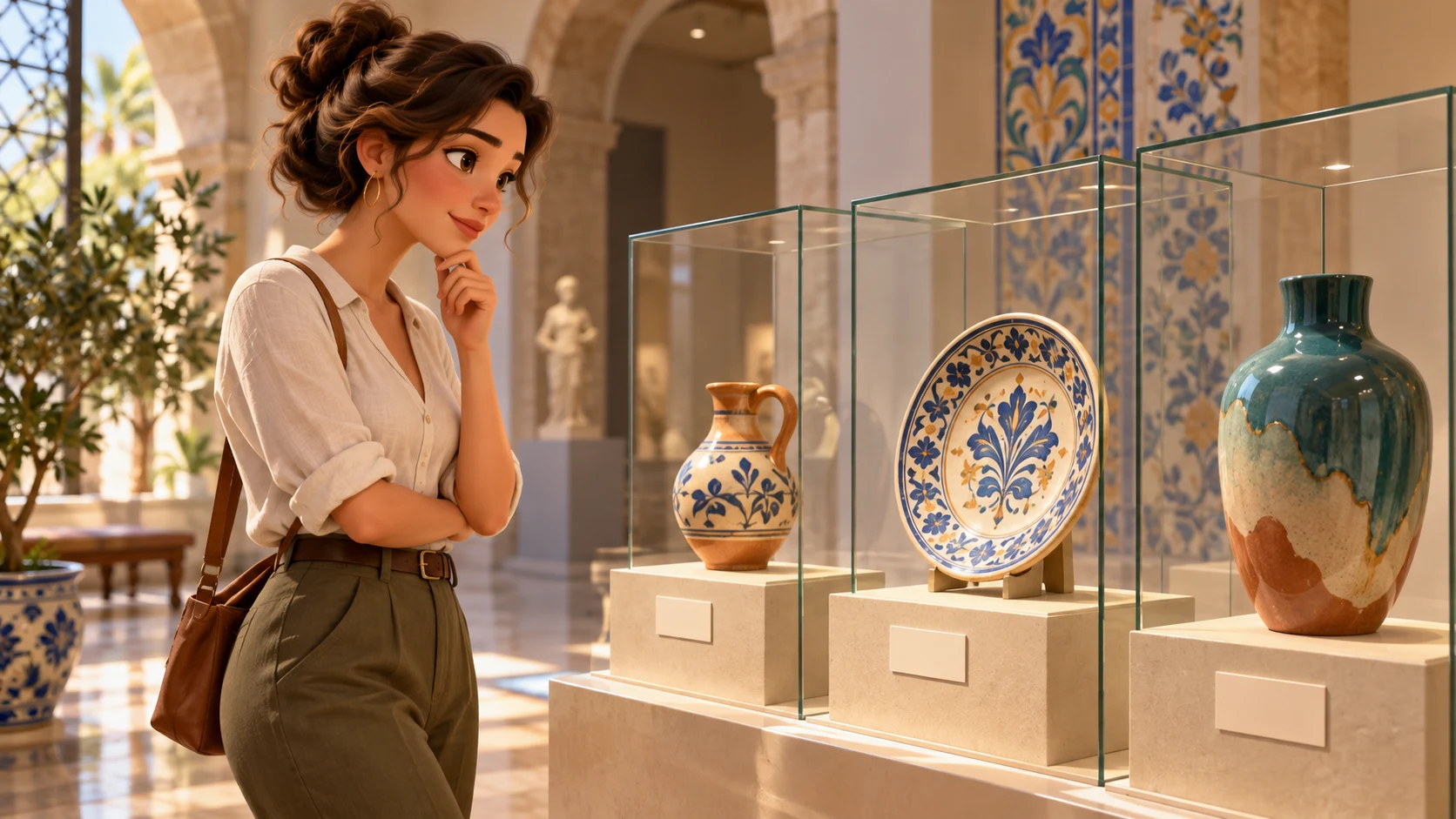
Valencia’s Ceramics Museum: three objects to look at in Spanish
Look closely at a small jug, a porcelain plate and an Artigas vase, with official object records and an observation sheet.
You can enjoy Valencia's National Ceramics Museum without trying to remember every dynasty, technique and date. Choose three objects with different shapes, look closely and give yourself a small Spanish task. A jug, a decorated plate and a vase offer enough variety for a visit that feels like looking at art rather than completing a vocabulary test.
This guide uses three named objects from the official collection records of the Museo Nacional de Cerámica y Artes Suntuarias González Martí, housed in the Palacio de Dos Aguas. Each record identifies an exhibition room. Those published locations help you plan; they do not guarantee that an object or room will be accessible on the day you arrive.
Prepare a three-object visit
Check the museum's official website for current visiting information, tickets and notices. Keep the object names and inventory numbers below in a note. They are more precise than asking for “the blue plate” in a ceramics museum with many decorated objects.
| Object | Inventory number | Exhibition room named in its official record |
|---|---|---|
| Jarrita esgrafiada | CE1/00566 | Sala de cerámica cristiana medieval, second floor |
| Plato de porcelana | CE1/11657 | Sala del alfarje, second floor |
| Jarrón, Josep Llorens Artigas | CE1/11597 | Sala de la creación cerámica del siglo XX, second floor |
The order here is a suggested learning sequence: shape, scene, surface. It is not a verified sequence of adjacent display cases. Follow the current room signs and ask staff where appropriate. If your time or energy suits only one object, use the jug exercise and stop there. A shorter attentive visit is still a complete activity.
If an object is temporarily unavailable, do not pretend you saw it. Use its official image and record later, and label your note “En la imagen de la ficha veo…”. Inside the museum, you may choose another accessible piece for the same observation task, recording its actual title. Keep the original object's history separate from the substitute.
Three kinds of sentence: observation, information and interpretation
Before your first stop, divide a page into three columns. “Veo…” records something visible. “La ficha indica…” records information supplied by a label or official catalogue. “Me parece…” records your interpretation. The same object can produce a useful sentence in every column, but the statements do different jobs.
For example, you may see blue decoration, read that an object is porcelain and feel that a scene looks lively. Seeing the colour does not establish the material, and your reaction does not establish the maker's intention. Keeping those distinctions makes your Spanish more precise and your museum conversation more interesting.
You can also leave a blank. If glare prevents you from seeing a detail, write “No distingo bien…”. If the label does not answer a question, write “Quiero saber…”. An honest gap is more useful than borrowing a confident description that you cannot connect to what is in front of you.
Object 1: the small jug, Jarrita esgrafiada
The official record for CE1/00566 describes a rounded body, two handles and incised diamond decoration. It identifies turquoise glaze details and places the piece in the medieval Christian ceramics room. Start with the shape before reading the longer technical explanation.
Looking task: find the mouth, body and handles. You do not need to judge the object by how modern jugs are used. Ask which part gives the silhouette its character. Is your attention drawn first to the widest section, the opening or the handles? Choose one and explain your choice.
At A1, try “Tiene dos asas” and “El cuerpo es redondeado”, if you can see those features clearly. At B1, connect an observation with a preference: “Me fijo primero en las asas porque…”. Complete the reason yourself. The task has no preferred opinion about whether this is the most beautiful object in the room.
Now read the word “esgrafiada” in the title. The catalogue describes incisions used in the decoration. Look for the pattern from the permitted viewing position; do not touch the surface or move around barriers to investigate it. If you cannot make out the lines, say so and use the catalogue description as information, not as something you personally observed.
Record one question: “¿Cómo se hacía esta decoración?” You are asking about a process. That is different from guessing that the pattern was painted with a brush merely because you can see colour. A later answer from a museum text can be added to the information column.
Object 2: the porcelain plate, Plato de porcelana
The record for CE1/11657 describes Chinese porcelain with blue decoration on white, a central hunting scene with riders and a floral border. It places the plate in the Sala del alfarje. Your task is to distinguish the centre from the surrounding decoration.
Looking task: spend a moment on the whole plate, then focus on the central scene. Finally look towards the edge. Write one sentence for each area using “en el centro”, “alrededor” and “en el borde”. These location phrases let you organise a description without listing every figure.
A useful frame is “En el centro veo…; alrededor hay…”. Complete it with what you can actually distinguish. If you recognise a horse but cannot identify another shape, keep that uncertainty: “Veo un caballo, pero no distingo bien esta figura”. There is no need to fill the gap with a plausible animal name.
The catalogue provides the scene's interpretation. Compare that explanation with your first impression. Did you recognise the activity before reading, or did the description help you understand the arrangement? You can say “Antes de leer la ficha pensaba…; después he entendido…”. This is a reflection on your reading, not a correction of the museum's attribution.
Finish by choosing whether the border or the centre holds your attention longer. Explain your preference through one detail. A partner can choose differently and still give a strong answer. This makes the plate a conversation subject instead of a list of facts one person recites to the other.
Object 3: a vase by Josep Llorens Artigas
The official record for CE1/11597 identifies stoneware with a brown glaze and slight black mottling. Its listed display location is the room devoted to twentieth-century ceramic creation. Here, give the surface and silhouette the attention you gave the plate's scene.
Looking task: choose three words about the visible appearance, then remove any word that depends on touching the object. “Marrón” describes colour. “Parece liso” describes a visual impression. Claiming that it feels smooth would require an experience you are not being invited to have.
Compare the vase with the plate from memory: what changed in the way you looked? Perhaps you searched for figures in the plate and followed an outline in the vase. Write “En el plato me fijé en…; en el jarrón me fijo en…”. Complete the two spaces with your own observations.
You do not need to invent a story about what the artist was feeling. If the surface reminds you of something, introduce the association with “Me recuerda a…”. Your personal connection can enrich a conversation as long as you present it as yours. “Me recuerda a una piedra” is different from claiming that the artist intended to represent a stone.
Finish with a question about a term from the record, such as “¿Qué significa gres en esta ficha?” Ask for an explanation you can understand rather than copying a long technical definition. The answer can become one new word linked to one real object.
Fourteen words you can use in these rooms
| Word | Use it for |
|---|---|
| la pieza | The object you are discussing when its exact name is not yet clear. |
| la jarrita | The small jug in your first task. |
| el asa | A handle; plural: las asas. |
| el cuerpo | The main body of a vessel. |
| la boca | The opening at the top. |
| el plato | The plate in the second task. |
| el borde | The edge you distinguish from the centre. |
| la escena | The depicted activity you discuss after looking. |
| el jarrón | The vase in your third task. |
| la superficie | The visible surface, without implying touch. |
| el esmalte | Glaze, when identified in the object's information. |
| el gres | Stoneware, as named in the Artigas record. |
| la porcelana | Porcelain, as named in the plate record. |
| la cartela | The museum label you read beside an object. |
Notice “el asa” in the singular and “las asas” in the plural. The noun is feminine; the singular article form does not make it masculine. You can say “un asa pequeña”. Learn the expression beside the jug rather than treating it as a detached grammar puzzle.
Your observation sheet, ready to copy
| Object and inventory number | Veo… | La ficha indica… | Me parece… / Quiero saber… |
|---|---|---|---|
| Jarrita, CE1/00566 | [one visible shape detail] | [one verified label detail] | [your reaction or process question] |
| Plato, CE1/11657 | [centre or border] | [material or scene information] | [your preference or reading question] |
| Jarrón, CE1/11597 | [colour or silhouette] | [material named in the record] | [your association or term question] |
Write one final sentence combining two columns, for example “Veo…, y la ficha indica…”. Keep the source words in your note if a fact comes from a record read on your phone. Do not attribute that fact to a physical label you did not read.
Five checks, with explanations
- “Veo dos asas.” Which column? Observation, provided both handles are visible from your position.
- “La ficha dice que es porcelana.” Which column? Information: the material comes from the record.
- “Me parece elegante.” Is this a catalogue fact? No. It is a personal response, and you can explain what prompted it.
- The object's record names a room. Does that guarantee today's display? No. Check current access and ask if the object is not there.
- You used the online image because the room was unavailable. What should your sentence say? “En la imagen veo…”, so the observation is accurately described.
After the visit, keep one object name, one useful word and one question you still care about. If you enjoy connecting city visits with language learning, explore Spanish immersion in Valencia. Your notes can become a conversation in class, with your own observations providing the subject.
















































![Spanish A2: a Grammar and Vocabulary Checklist [2026]](https://mduvwmfuxtdyzbiplsbj.supabase.co/storage/v1/object/public/prod-assets/blog/ispanskiy-a2-chek-list-grammatiki-leksiki.webp)



