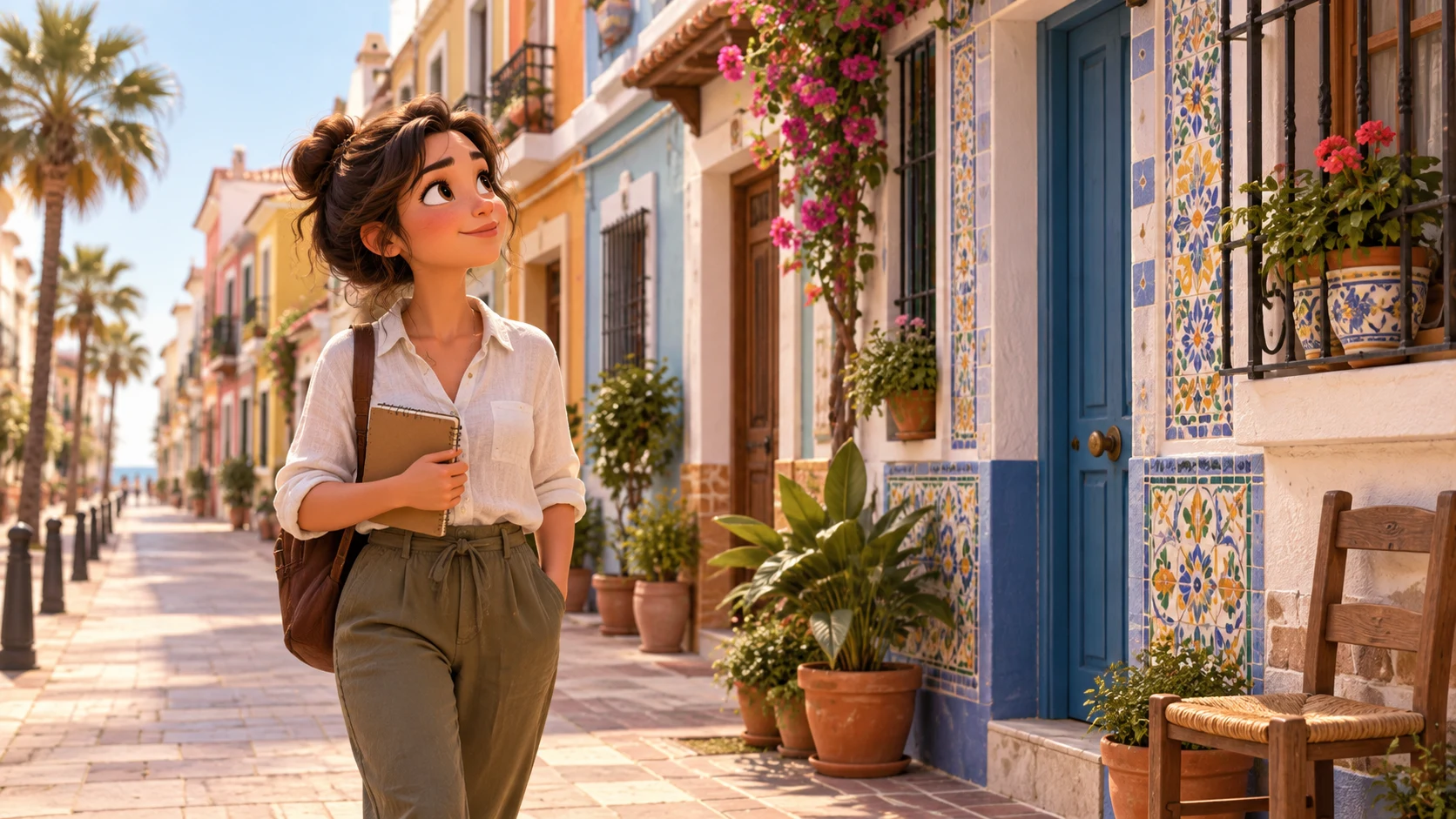
A Cabanyal walk: five stops and five small Spanish tasks
A two-kilometre exterior route through the market, church, theatre, Rice Museum and La Fábrica de Hielo, with a shorter option.
A walk through El Cabanyal can become a small Spanish practice session without turning every shopkeeper into your teacher. Choose five public-facing buildings, give yourself one observation task at each and keep the rest of the walk for looking around. You can complete all the tasks from outside, including when a building is closed.
The route below connects the Cabanyal market, the church of Nuestra Señora del Rosario, Teatre El Musical, the Rice Museum and La Fábrica de Hielo. It is an original five-stop selection based on the city's cultural map and geographic data. It has not been personally walked for this article, and the mapped distance is an estimate rather than a promise about street conditions on your visit.
Your route: five stops and about two kilometres
Start at Mercat del Cabanyal and finish at La Fábrica de Hielo. The full route is approximately two kilometres, excluding your journey to the start and any detours. The estimate comes from the municipal route geometry plus the connection along Eugeni Viñes to the final stop. It includes a coastal approach rather than claiming to be the shortest possible route.
Open the official Cabanyal cultural route map. Our first four stops follow its numbered locations in reverse: 7, 6, 5 and 4. Continue towards the coast along its line past map points 2 and 1, then follow Carrer d’Eugeni Viñes north towards point 12. Those two intermediate landmarks are navigation references, not additional exercises.
| Our stop | Official map number | Map reference, latitude and longitude |
|---|---|---|
| 1. Mercat del Cabanyal | 7 | 39.467497, −0.333286 |
| 2. Nuestra Señora del Rosario | 6 | 39.464842, −0.331961 |
| 3. Teatre El Musical | 5 | 39.464702, −0.332009 |
| 4. Museo del Arroz | 4 | 39.463206, −0.331897 |
| 5. La Fábrica de Hielo | 12 | 39.469601, −0.324864 |
These coordinates identify the municipal map points; they do not certify an entrance, a crossing or step-free access. Use public pavements and the crossings actually available. If works or a closure interrupt the mapped line, choose a suitable public alternative or shorten the walk. Do not enter a building simply to complete a language task.
For a short version, do only the market, church and theatre. The mapped connection between these three stops is about 450 metres. The church and theatre are close together around Plaça del Rosari, so this option gives you three different observations without the longer coastal section. Your return journey is additional.
Before you leave: make a five-line notebook page
Write the five names in order, leaving space beneath each for a Spanish sentence. Bring the map in a form you can read while stopped. You do not need to keep a screen open as you walk. Decide whether today you want basic observations or a more detailed comparison.
At A1, use “Veo…” for something you can see and “Hay…” for something present in the scene. At B1, add a reason or comparison: “Me llama la atención… porque…” or “Esta entrada es más… que…”. Choose a visible detail that supports the sentence. A complex adjective is less useful than an accurate observation.
Do the exercises from a place where you do not obstruct an entrance or pavement. Speaking aloud is optional. You can write silently and practise the sentences later. Residents, customers and staff are using the neighbourhood for their own day, so no task requires them to answer you or appear in a photograph.
Stop 1: read the market as a public sign
The municipality lists Mercado Municipal Cabanyal at Justo Vilar. For this walk, the exterior is enough. Look for the displayed building name or a public notice visible from the street. If trading is taking place, stay clear of people moving goods and entering the market.
Your task: copy one short piece of public wording and explain what it tells a visitor. You might identify the market's name, an entrance sign or a notice. Copy only what you actually find; the exercise does not depend on a particular poster being present.
A basic response could be “En el letrero pone…” followed by the exact words. Add “Es el nombre del mercado” if that is what you copied. For a more advanced response, distinguish a name from an instruction: “Este texto identifica el edificio; este otro indica dónde entrar”. Use the second part only if you see such a sign.
If the market is closed: the name and exterior still provide material. Describe one visible feature with “La entrada está…” or “Veo una puerta…”. You do not need to infer opening hours from a shutter. If opening times matter to you, check the current official information separately.
Stop 2: describe the church without inventing a story
Follow the map to Nuestra Señora del Rosario. The municipal monument entry locates it at Plaza del Rosario, 4. This is a place of worship, so keep the task outside and leave people attending services room to pass.
Your task: choose two visible architectural details and describe their position. Useful words are “fachada”, “puerta”, “ventana”, “arriba”, “abajo” and “al lado de”. You do not need to name the architectural style or know a construction date to complete the exercise.
Write a sentence frame such as “Encima de la puerta veo…” and complete it only after looking. Then check whether you described a visible object or guessed its meaning. “Parece…” introduces an impression; it does not turn that impression into an architectural fact.
For a partner exercise, one person describes a detail without pointing and the other tries to locate it. If they identify a different feature, add a position or shape word. The correction is the useful part: you learn which information your first sentence was missing.
Stop 3: compare two entrances at Teatre El Musical
Move to the nearby theatre. The city's Teatre El Musical page identifies it as a public cultural space in the neighbourhood. You do not need a ticket or a performance to use the exterior for this exercise. Entering for a show is a separate choice with its own current conditions.
Your task: compare one feature of the theatre entrance with one feature you noticed at the church. Keep the comparison visible and narrow. Consider the shape, proportions or lettering rather than making a claim about which building is more important to local residents.
Try “Esta puerta es más… que la anterior” or “Las dos entradas tienen…”. If you cannot find a useful comparison, write “Son diferentes en…” and identify one difference. There is no required answer saying one entrance must look bigger, older or more attractive.
If a programme is visible, you may add a reading task: identify a title, date and start time from the same entry. Do not combine the date from one listing with the time from another. If no programme is visible, your entrance comparison already completes the stop.
Stop 4: turn a museum name into a question
Continue to Museo del Arroz. The municipal museum description places it in a former rice mill and explains its connection with processing rice. That background gives you a different subject from the market or theatre, even though this route remains outside.
Your task: separate something the name tells you from something you would need to investigate. “Arroz” identifies the subject. It does not tell you the price of a ticket, the length of a visit or which machines you will see today.
Write two lines: “Por el nombre sé que…” and “Quiero saber cómo…”. A possible second line is “Quiero saber cómo se trabajaba aquí”. That is an original visitor question, not a historical claim. If you later choose to visit, use the official museum information to plan it.
For A1, simplify to “Es un museo sobre el arroz” and “Tengo una pregunta”. For B1, explain which part interests you: the building, the work or the processing equipment. Your preference is valid without inventing details about people who worked in the mill.
Walk towards the coast, then make the final stop
After the Rice Museum, use the official map's coastal connection past its Sorolla monument and Las Arenas references. These help you follow the mapped streets. At Carrer d’Eugeni Viñes, continue north to the final point. Keep checking street names when stopped; a map line is not a live report of crossings or temporary works.
The municipal cultural directory describes La Fábrica de Hielo as an independent creative space. The historical name and present cultural use give you a useful language contrast without needing to attend an event.
Your task: write one sentence about the name and one question about current use. For example, “El nombre menciona el hielo. ¿Qué actividades se anuncian ahora?” If there is a readable public programme, select one entry and record exactly what it says. If there is none, leave the question for later.
Do not assume that a listing found online is happening today. Check the event's date and year, then distinguish “se anuncia” from “está ocurriendo”. You can complete the stop by describing the exterior and writing your question even if the space is closed or there is no event.
Your five-task sheet
| Stop | Keep this evidence |
|---|---|
| Market | One short public text and its purpose: En el letrero pone… |
| Church | Two visible details and a position: Encima de… / Al lado de… |
| Theatre | One comparison supported by what you saw: Esta entrada… |
| Rice Museum | One known subject and one open question: Sé que… / Quiero saber… |
| La Fábrica de Hielo | A name observation and a current-programme question, without assuming an event. |
Check the meaning of your notes
- You copied a building name. Have you established its opening time? No: a name identifies the place; hours need separate information.
- You wrote that a doorway looks old. Have you established a construction date? No: an impression and a dated historical claim are different.
- You saw an event poster without checking the year. Can you say it happens tonight? No: read the full date and the relevant entry.
- You could not enter a building. Have you failed the route? No: all five tasks have an exterior version.
- Your partner chose a different adjective for the same façade. Must one answer be wrong? Not necessarily: compare the observations that support each description.
After the walk, choose your strongest sentence and improve one unclear phrase. Keep the original observation beside it so you can see what changed. If this kind of city practice suits the way you want to learn, explore Spanish immersion in Valencia. Bring your own questions back to class; this independent walk is not a promise of a school-organised excursion.

















































![Spanish A2: a Grammar and Vocabulary Checklist [2026]](https://mduvwmfuxtdyzbiplsbj.supabase.co/storage/v1/object/public/prod-assets/blog/ispanskiy-a2-chek-list-grammatiki-leksiki.webp)



