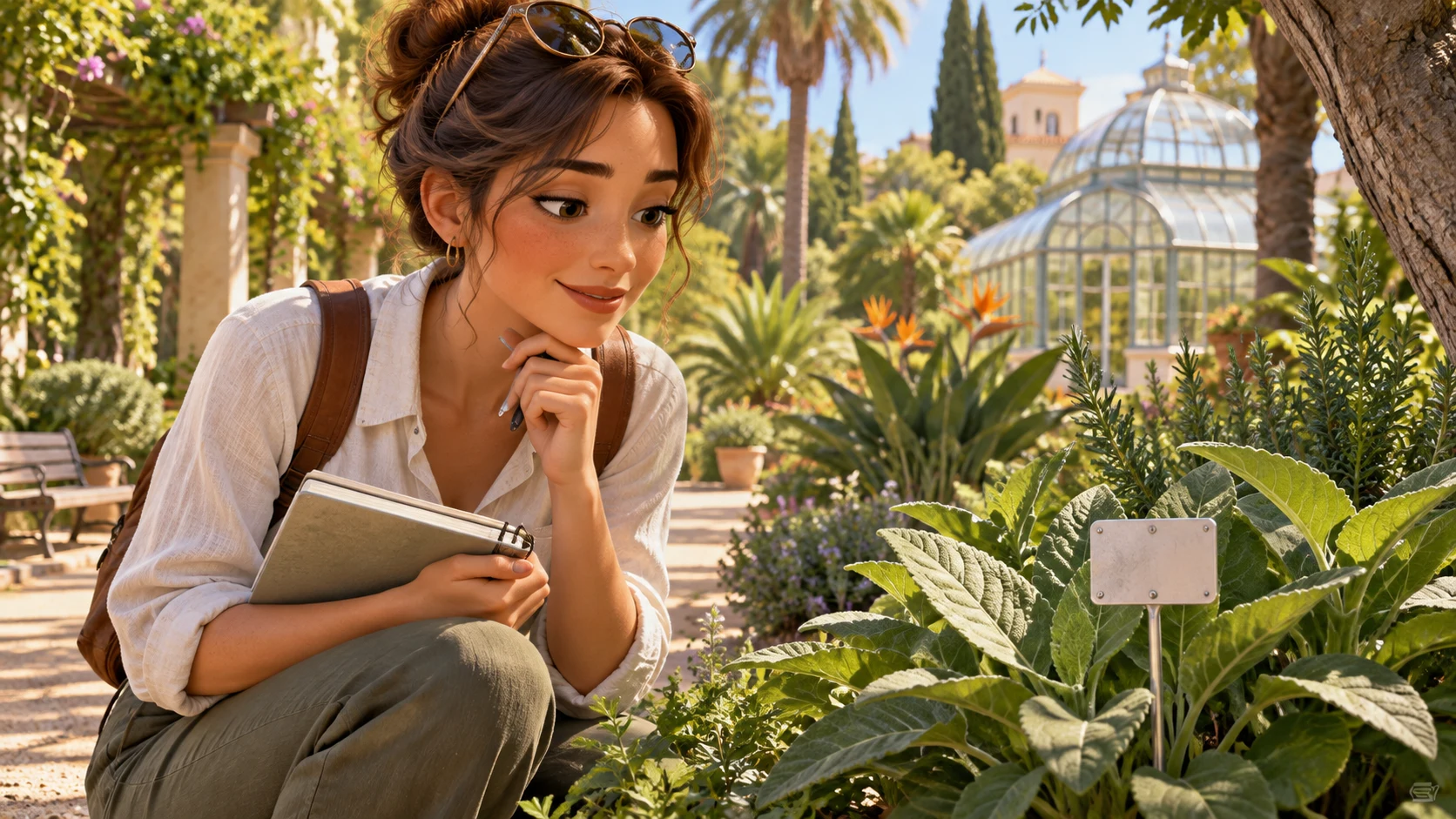
Valencia’s botanical garden: three stops for Spanish practice
Use the official map for a quiet-paced visit, with three observation tasks, a teaching label and a shorter route.
A botanical garden gives you time to notice one shape, read one label and ask one useful question. You do not need to identify every plant or wait for a particular flowering season to practise Spanish. At the Jardí Botànic de la Universitat de València, a short route through three mapped collections can give your visit a gentle structure.
The plan below uses Escuela Botánica, Palmeras and Acuáticas, named on the garden's official visitor map. You will describe a visible detail, separate a scientific name from ordinary language and compare two observations. There is a shorter option, and every task can be completed silently. Choose the amount of practice that fits your day.
Prepare the visit before choosing the tasks
The garden's entrance is on Carrer de Quart, 80. Check its official visiting information and current ticket options before setting out. Opening hours, ticket conditions and any notices belong to the date of your visit; they are not established by a photograph or an old travel post.
A self-guided visit and a guided activity are separate choices. If you want a guide, consult the garden's guided-visit information and check the language, availability and booking conditions. The exercises here do not require a guide and do not imply that a garden visit is included in a language-school course.
Bring a small note with three headings: “Veo…”, “En la etiqueta pone…” and “Quiero saber…”. The first records an observation, the second records actual wording and the third keeps a question open. A phone is enough, but stop before reading or writing so you can keep the paths clear.
Three named zones on the official map
Open the garden's official visitor map; the Spanish plan is included in the multilingual booklet. The entrance appears at the bottom of the plan. Locate numbers 15, 11 and 17 before walking. They refer to collections, not three individual plants you must find.
| Order | Map collection | Your task |
|---|---|---|
| 1 | 15 — Escuela Botánica | Choose a visible shape or size detail from a public path. |
| 2 | 11 — Palmeras | Read an accessible label, separating its different fields. |
| 3 | 17 — Acuáticas | Compare two observations and write one open question. |
From the Quart entrance, begin in the grid of beds marked 15. Continue along the permitted paths towards the eastern side, where the plan marks a strip of Palmeras with number 11. Follow that side towards the water area marked 17. Palms appear in more than one part of the map; the eastern strip gives this particular sequence a clear reference.
This is a route proposal based on the published plan, not a report that every path has been personally inspected. Follow the signs and any instructions on the day. If a section is closed, remain on open paths and use a previous observation for the next task. Do not cross a planted bed to make the drawn sequence work.
Short version: stay in the accessible part of Escuela Botánica near your arrival route. Choose one visible plant and one readable label there. Do the comparison using two details from that same area, then return by the open visitor path. You will have practised all three skills without reaching every collection.
Task 1 in Escuela Botánica: describe what you can see
Choose a plant that is easy to observe from the path without leaning into a bed. Begin with a large feature: the outline, a trunk, a branch or a visible leaf. Look before reaching for a word. If you cannot see a feature clearly, choose another one rather than trying to match a sentence from this article.
Useful words are “hoja”, “tronco”, “rama”, “alto”, “bajo”, “grande”, “pequeño”, “redondeado” and “alargado”. You do not need all of them. Select two that fit the same observation. “Veo una hoja alargada” is a complete sentence; it gives you a visible object and a shape without requiring a species identification.
Pay attention to the noun when choosing the adjective: “una hoja pequeña”, “un tronco alto”, “unas ramas largas”. In these examples, the adjective agrees with the noun. Practise one real combination rather than reciting a full grammar table while standing in the garden.
For a second sentence, add location: “La hoja está junto al camino” or “Veo una rama por encima de…”. Complete the reference with something you can see. Position words help another person find your detail. If they point to the wrong leaf, revise the description by adding a shape or relative position.
Season-independent alternative: describe a trunk, branch or overall silhouette if leaves or flowers are not suitable for your task. You are not required to find a blossom. “Hoy no veo flores en esta planta” is a limited observation about this plant today; it does not establish that the species never flowers.
Task 2 by Palmeras: read a label without translating everything
Find a label readable from the permitted path. The map's collection name helps you orient yourself, but the label may contain more detailed information. Start by identifying which part is the scientific name and whether a common name or family is also supplied. Do not assume that every physical label uses the same layout or language.
A scientific plant name is not an ordinary Spanish sentence. In a simple two-part species name, you will often see a capitalised genus followed by a lower-case specific word. Extra information may follow. For this exercise, copy the name as written instead of trying to translate each part into everyday Spanish.
A common name serves a different purpose. The garden's official record for Brugmansia sanguinea, for example, distinguishes the scientific name from the common names “trompetero rojo” and “floripondio rojo”. This is a reading example, not an instruction to locate that plant in the palm collection.
A teaching label you can practise with
Original teaching layout, based on the names in that catalogue record; this is not a photograph or transcription of an on-site label.
| Nombre científico | Brugmansia sanguinea |
|---|---|
| Nombre común | Trompetero rojo |
| Familia | Solanaceae |
| My observation today | [leave blank until you actually observe a plant] |
In the model, the first row names the species scientifically, the second offers a common name and the third gives a family. None of those rows tells you that a flower is visible today. The adjective in a common name should not become an invented observation about the specimen in front of you.
Now return to your real label and write “En la etiqueta pone…” followed by one short field. If you cannot identify the language of another line, write it down as a question. A Valencian name, a Spanish name and a scientific name may require different kinds of reading; you do not need to solve all of them on the path.
Task 3 at Acuáticas: compare two observations
Use the public path around the area marked 17 on the plan. Choose two visible features that can sensibly be compared. They may be two leaves, two outlines or one detail here and one you recorded earlier. Do not reach over the water or move a plant to create the comparison.
Try “Esta hoja es más grande que aquella” only when both leaves are visible and the comparison makes sense from your position. If distance makes one look smaller, choose a less ambiguous feature. “Estas dos hojas tienen formas diferentes” can be more accurate than pretending you measured their sizes.
For a basic version, write two separate statements: “Esta hoja es alargada. Esta otra es redondeada”. For a longer version, add your preference: “Me interesa más la primera porque…”. Explain a feature you noticed, not a supposed botanical advantage that you have not researched.
If the water collection offers no suitable pair that day, compare your notes from the first two stops while remaining on an open path. The skill is comparing observations, so the exercise does not depend on a particular water plant, seasonal flower or animal appearing for you.
Finish with one question: “¿Cómo se llama esta planta en español?” or “¿Dónde puedo leer más sobre esta colección?” Keep the question even if nobody is available to answer. It can guide a later catalogue search or become a useful conversation with your teacher.
Ask a question when the situation allows
If a member of staff is available and the question fits their role, begin with “Disculpe, ¿puedo hacerle una pregunta?” Then ask one thing. “¿Esta es la zona de plantas acuáticas?” is a location question; “¿Cómo se llama esta planta en español?” is a naming question. Combining them with several technical questions makes it harder to get a useful short answer.
An original practice exchange could be: “Busco la zona marcada con el número diecisiete. ¿Voy bien por aquí?” The partner replies with a direction on the map you are both using. Check that you have understood by repeating the named zone. In a real visit, follow the actual answer rather than a memorised route instruction.
If staff are busy, write the question and continue your visit. You can still use the official catalogue afterwards. The quality of your practice does not depend on obtaining an unscheduled explanation from someone working in the garden.
Keep the observation gentle on the garden
The garden's published rules require visitors to use designated paths, avoid entering beds and avoid removing plant parts. Keep your notebook task away from entrances and narrow passages. For these exercises, observation is enough: there is no need to touch, collect or taste anything.
If you want a photo, check the applicable rules and avoid including other visitors without their agreement. A written description works equally well. Do not step into a planting area to remove glare from a label or get a clearer background.
Your three observation cards
| Card | Fill these fields |
|---|---|
| 1. Shape | Collection: … / Veo… / The detail that supports my adjective: … |
| 2. Label | Exact field: … / En la etiqueta pone… / I still need to understand: … |
| 3. Comparison | Observation A: … / Observation B: … / My comparison: … / Quiero saber… |
Check your reading: five answers
- A label gives a scientific name. Must you translate it as Spanish? No. Copy it accurately and distinguish it from a common name.
- A common name contains “rojo”. Does that prove you see red flowers today? No. Today's observation needs to come from what is visible.
- Your planned section is closed. Should you cross a bed to reach it? No. Use open paths and the short version or earlier notes.
- You cannot see suitable leaves. Can the first task still work? Yes. Describe a trunk, branch or silhouette instead.
- Your partner writes a different comparison. Is it necessarily wrong? No. Ask which observations support it and check that the wording matches them.
Before leaving, save three sentences and one word in context. If you enjoy trying Spanish around the city and returning to questions in class, explore Spanish immersion in Valencia. Your next conversation can start with a detail you noticed, rather than a list of plant names you felt obliged to memorise.



















































![Spanish A2: a Grammar and Vocabulary Checklist [2026]](https://mduvwmfuxtdyzbiplsbj.supabase.co/storage/v1/object/public/prod-assets/blog/ispanskiy-a2-chek-list-grammatiki-leksiki.webp)



